P.A.R.T.S

Photographic Area Rug Tracking System

Never lose a rug again.

P.A.R.T.S is rug tracking software for cleaning plants. Photograph every rug at collection, tick it through your own wash stages, and prove what condition it arrived in, from a phone, on the floor, with wet hands.

Built and used daily in a working South African rug cleaning plant.

A rug's journey, as your plant already runs it

  • Received
  • Dusting
  • Washing
  • Rinsing
  • Spinning
  • Drying
  • Grooming
  • Inspection
  • Ready for delivery

These are the default stages. Rename them, reorder them, delete the ones you do not do. It should read like your plant, not like software.

The method

How to track rugs in a cleaning plant

Rugs get lost in plants for one reason: once a rug is off the van and on the floor, nothing about it says whose it is. Tracking rugs means giving every rug an identity at the moment it leaves the client's house, and recording every time it moves. Five steps, and none of them need a barcode.

1

Photograph the rug before it leaves the client

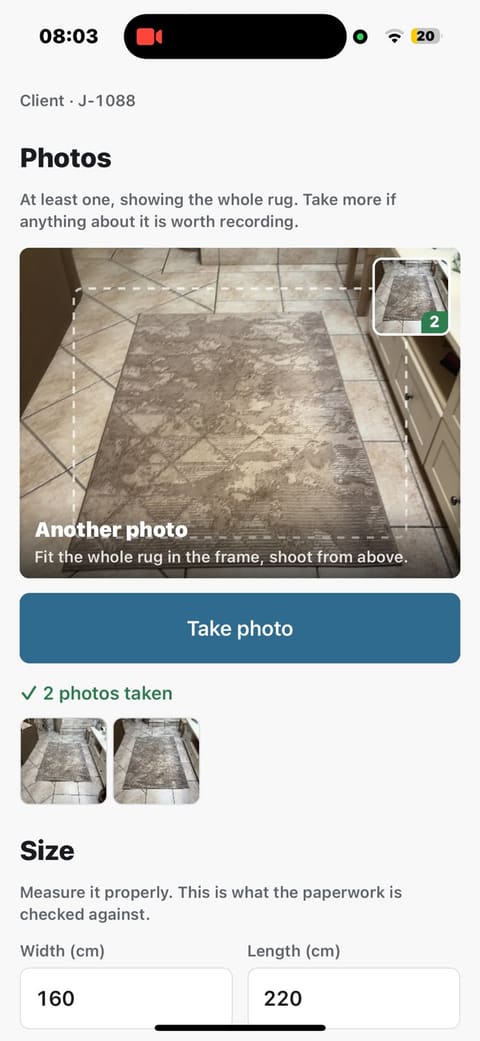
The photograph is the identity. A number written on a job card tells you nothing when you are standing in front of forty rolled rugs; a picture tells you immediately. Take it in the lounge, before the rug is rolled.

2

It gets assigned a job card

One job card per client collection, numbered J-1042, with each rug on it numbered J-1042-03. The job card is the paper that travels with the rugs, and the job card plus the photograph is what identifies a rug, not a tag that falls off in the wash.

3

Record the size, fibre and any existing damage

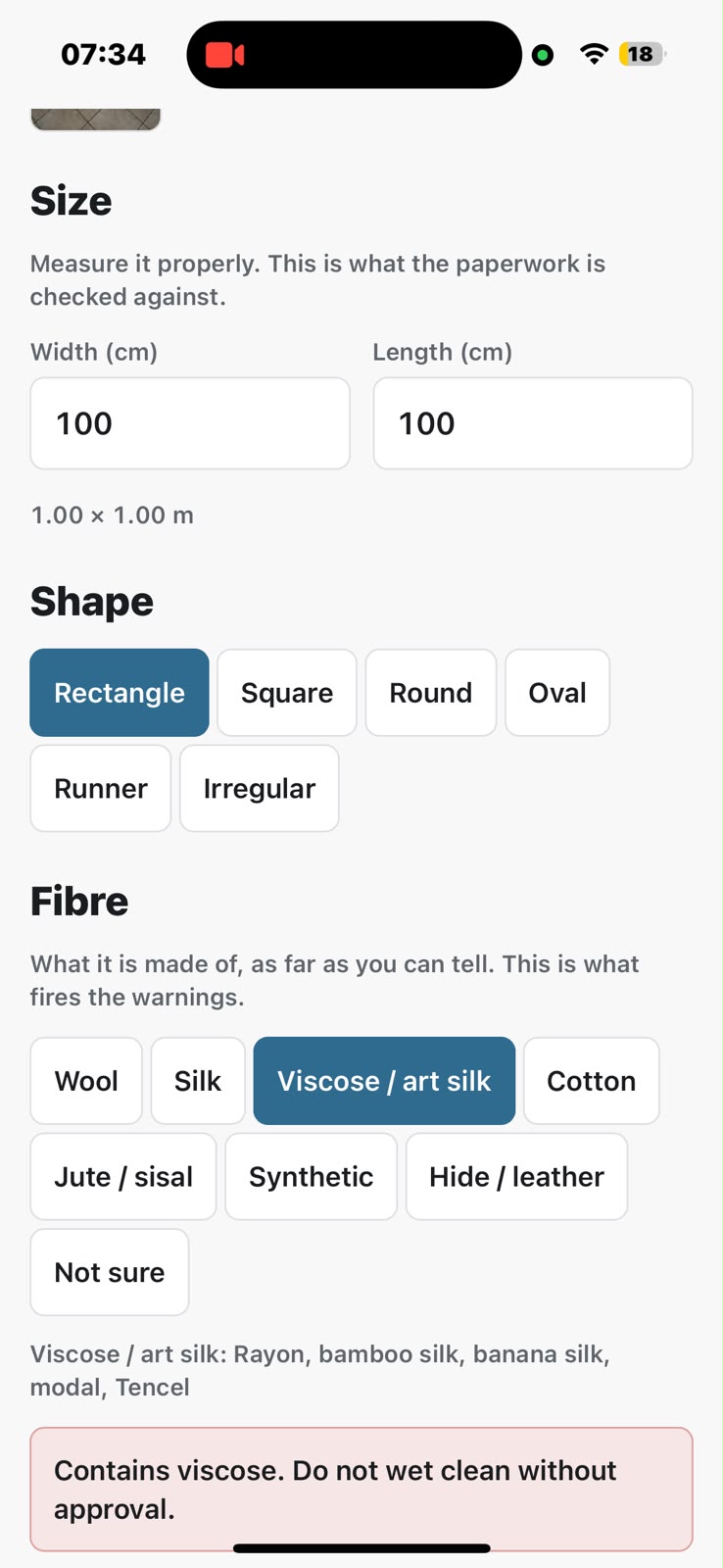
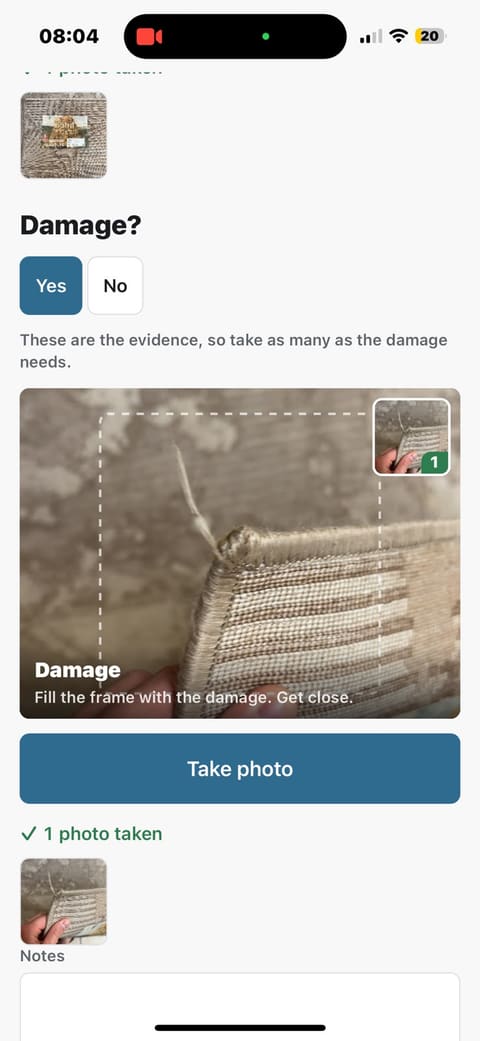
Measure it properly, note what it is made of, and photograph any damage that is already there. This is the record you will produce in four months when somebody says the fringe was fine when they gave it to you.

4

Tick the rug through each stage as it moves

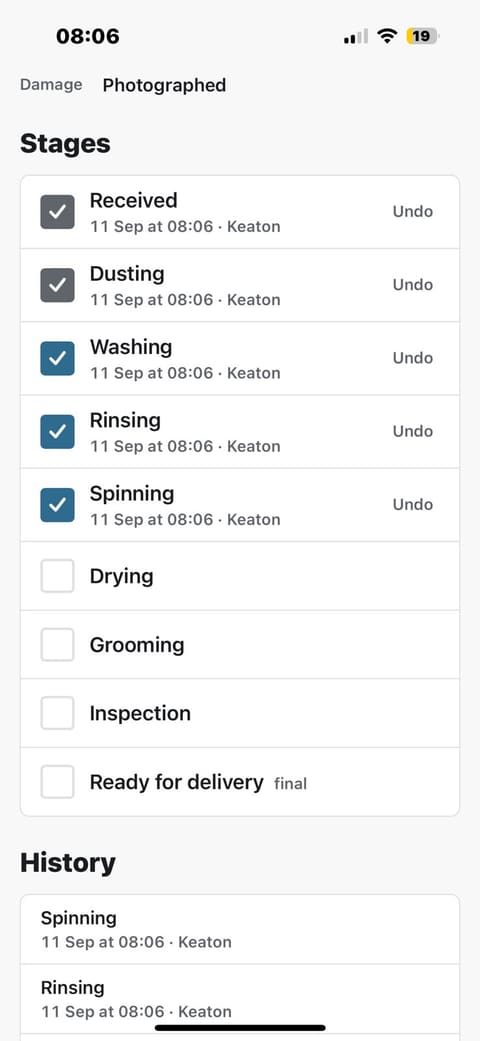
Received, dusting, washing, drying, and so on through your own process. One tap per rug, stamped with the time and the operator's name. The stage is the answer to "where is my rug?". A plant whose stages are places does not need a second list of shelf numbers going stale.

5

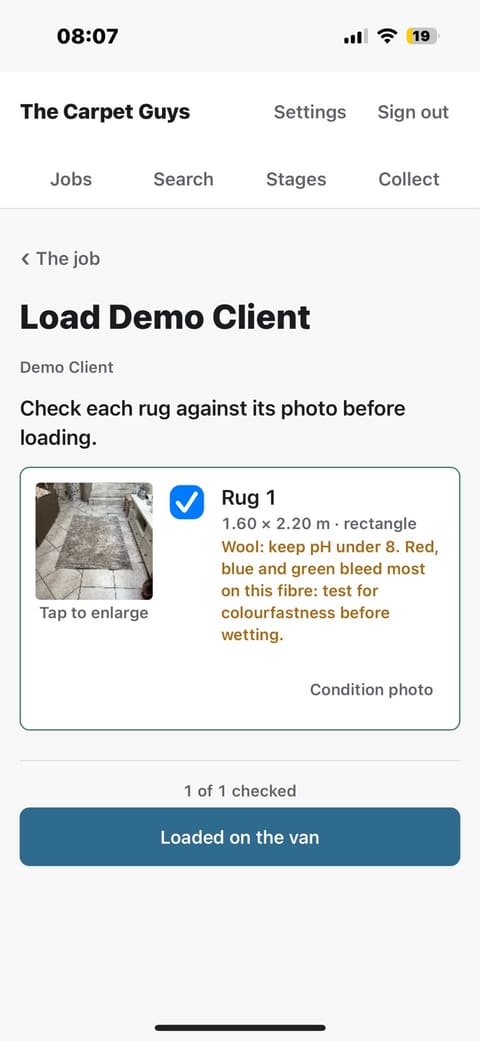
Check each rug against its photograph before it loads

At the van, compare the rug in your hands to the picture taken at collection. This is the last moment a mix-up is cheap to fix, and it is the step that stops Mrs Naidoo receiving Mr Botha's rug.

What it does

One job, done properly

If a feature needed a subsystem to explain it, it is not in here.

Intake

Every rug has a photograph and a number

Booked in at the client, on a phone, in under a minute. The number goes on the job card; the picture is how anyone recognises it later.

On the floor

You always know what stage it is at

Your own process, your own stage names. One tap per rug, timestamped, with the operator's name on it. "Where is Mrs Naidoo's rug?" takes one search.

Evidence

Damage disputes end quickly

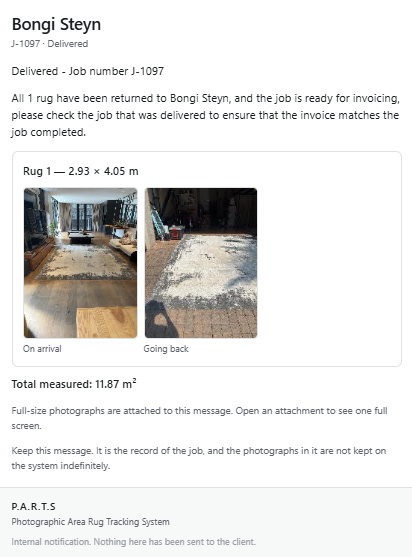
Condition photographs from the day of collection, and a record of who did what to the rug and when. One argument settled pays for a year of this.

Prevention

It warns your team before the wash bath

Tap "viscose" at intake and the warning appears immediately, and again on every stage screen for that rug. It is the mistakes that never happen that you never hear about.

In the van

It works with no signal

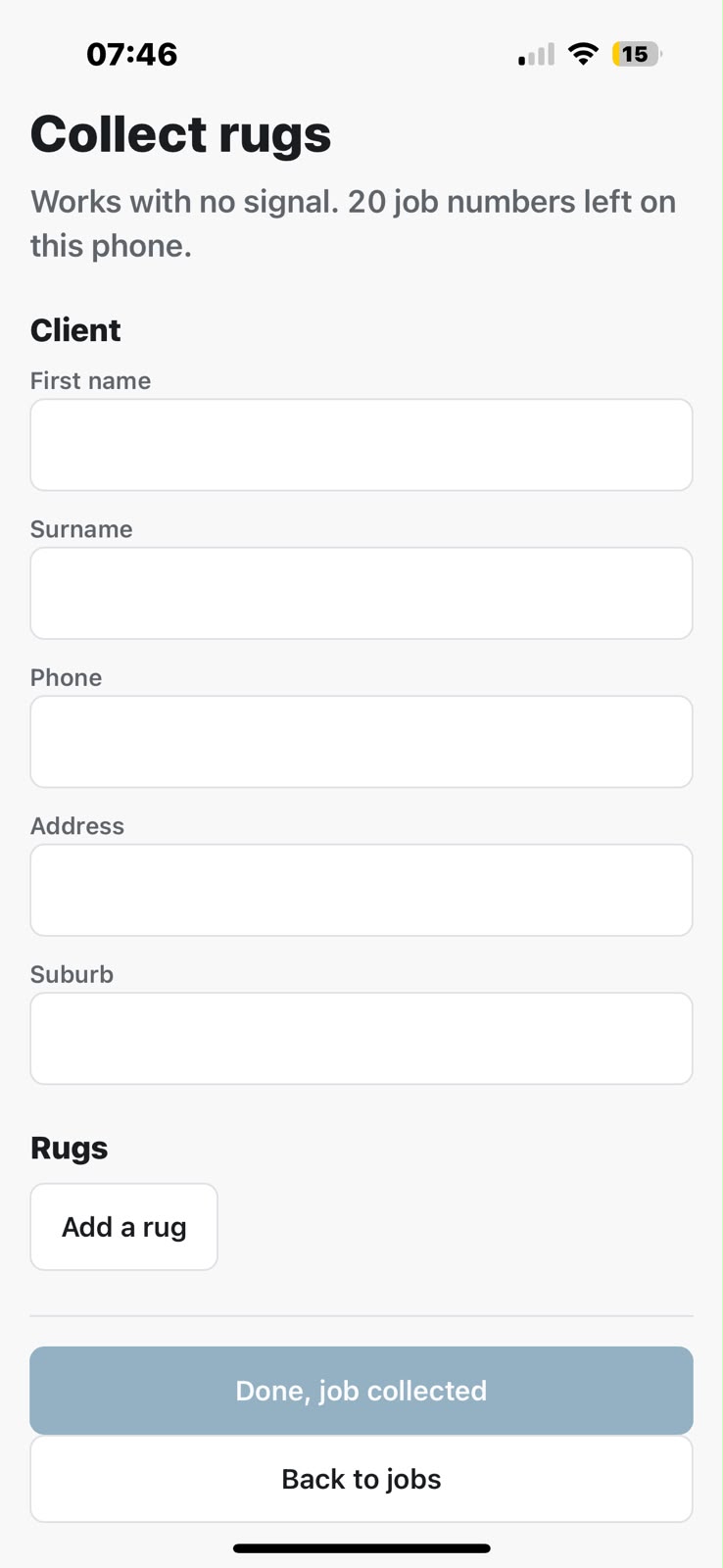
Collect rugs at a client with no reception at all: photographs, sizes, damage notes, the lot. It holds them on the phone, says plainly that nothing has been sent yet, and sends when you are back in range.

Storage

It never turns into a bill

Photographs are compressed when a job is delivered and deleted thirty days later. The written record (client, size, damage, who did what) is kept for good.

Deliberately absent

What it is not

Half of what makes this fast on a plant floor is what was left out.

  • Not an invoicing or accounting package. It tracks rugs. Your books stay where they are.
  • No barcodes, tags, QR codes or scanners to buy, lose, reprint or pick out of a wash bath.
  • No app store. It installs to the home screen from a web address, on any phone your staff already own.
  • No client portal and no automatic emails to your customers. The office phones them, the way it already does.

Ownership

Your data is yours

  • Every plant gets its own separate database. Nobody shares a table with anybody, and there is no shared pool of your clients' details.
  • Backed up nightly, automatically, and you can have a full export of everything whenever you ask for it.
  • If you leave, you take it with you. That is the deal, and it is why people trust it.

Price

One number, whatever your volume

The same price whether you do ten rugs a day or a hundred.

R2 100 once, to set you up and train your team
R900 per month, everything included

No per-rug charges, no tiers, no annual contract. Setup includes configuring your stages, your staff and your rug colours before you start.

Straight answers

Questions rug cleaners ask

What is the best way to keep track of rugs in a cleaning plant?

Photograph each rug at collection, give it a job number written on the paper job card, and record every stage it passes through. The photograph identifies the rug when nothing else can, the number ties it to the client's paperwork, and the stage history answers where it is and what has been done to it.

Physical tags are the common alternative and they fail in predictable ways: they come off in the wash, they get reprinted wrong, and a rug with no tag is a rug with no identity.

Do you need barcodes or RFID tags to track rugs?

No. Barcodes and RFID assume you can attach something to the item and that it survives the process. Rugs go through dusting, immersion, spinning and drying, and anything attached either comes off or has to be removed and reattached at every step.

A photograph taken at collection, a number on the job card, and a person comparing the two is the mechanism most plants already use informally. P.A.R.T.S makes it reliable rather than replacing it.

How do you prove a rug was already damaged when it arrived?

Photograph the damage at the client's house, before the rug is rolled or loaded, and record a written note beside it. A dated photograph taken at collection, together with a stage history showing who handled the rug and when, settles almost every dispute in one conversation.

In P.A.R.T.S those condition photographs are kept while the job is open and for thirty days after delivery, and the written damage notes are kept permanently.

How do rug cleaners avoid mixing up customers' rugs?

By checking each rug against its collection photograph at the moment it is loaded for delivery. Mix-ups almost never happen on the plant floor. They happen at the van, when similar rugs from different jobs are being loaded at the same time.

P.A.R.T.S puts a checklist at exactly that moment: each rug on the job with its photograph and dimensions, ticked off as it goes onto the van. The job cannot be marked delivered until it has been through that step.

Which rug fibres need a warning before washing?

Viscose and art silk, jute and sisal, and anything tanned such as hide or leather should not be wet cleaned without a deliberate decision, because they stain, shrink or fall apart. Wool, silk and cotton need care over pH and agitation rather than avoidance.

P.A.R.T.S asks for the fibre at intake and shows the warning immediately, then again on every stage screen for that rug, so the warning reaches the person at the wash bay rather than staying on a form.

Does it work without an internet connection?

In the van, yes. Collecting rugs at a client and signing off a delivery both work with no signal at all. The phone holds the photographs and details and sends them when it is back in range, showing plainly that nothing has been sent yet.

On the plant floor, no, and deliberately. Stage ticks are never queued: a tick that looks saved but is not is worse than one that visibly failed.

What does rug tracking software cost in South Africa?

P.A.R.T.S is R2 100 once for setup and training, then R900 a month with everything included, with no per-rug charges, no tiers and no annual contract. The price is the same whether the plant does ten rugs a day or a hundred.

How long does it take to book a rug in?

Under a minute per rug on a phone: one photograph, the size, the shape, the fibre, the colours, and whether there is damage. The whole intake is designed around an operator with one free hand, and it is timed with a stopwatch on real hardware rather than estimated.

Next step

Have a look at the real thing.

It is easiest to show you. I run a rug cleaning plant myself and this is what we use every day. I will come to you, show you the real system with real jobs in it, and let your own operators book in a rug and see how long it takes them.